Popeyes®
- 4.9
- Rating
- 10.00M
- Installs
- Free
- Price

 Analysis by App-foxy
I found the Popeyes® App most useful when a food decision involved more than one person. On a busy evening, one person can check the menu while another decides what sounds good, and the order can be handled without passing around a paper menu or trying to remember every choice. That sounds simple, but it is exactly where a restaurant app earns its place: reducing small bits of friction when everyone is hungry.
This is a free Food & Drink app from Popeyes Louisiana Kitchen, Inc., built around access to the restaurant’s menu and ordering experience. It has reached over five million installs and holds a 4.9 average from around 167 thousand ratings, which suggests that many users find it dependable for the basic task it is designed to handle. I would not treat those numbers as a guarantee that every visit will be smooth, though. Restaurant apps are only as useful as the location, availability, and timing behind the order.
Using it when the whole household is deciding
The strongest everyday use case is a shared meal where nobody wants to be the single person responsible for guessing what everyone else wants. I can imagine opening the app in the kitchen, checking the available choices, and letting each person make a decision before the order is submitted. That approach is better than one person building an order from memory, especially when different people want different combinations or sides.
You May Also Like

 Blood Strike: 2.5 Anniversary
Blood Strike’s Loadouts Turn Every Drop Into a Tactical Gamble
A close look at Blood Strike’s custom loadouts: how fast access to signature weapons reshapes its battle royale rhythm, rewards preparation, and narrows the gap between fights.

 Pandora - Music & Podcasts
Pandora’s Music Is Easy to Start, but Harder to Recover
Pandora’s strength is its low-effort path from a seed to a station. Its weak spot is how much confidence it asks you to place in connection, setup, and quiet recovery.

 8 Ball Pool
 Is Built on Rivalries, Rematches, and Routine
A close look at the rivalries, rematches, shared routines, and unanswered safety questions that turn a quick pool match into a persistent mobile community.

 Samsung Music
’s Quiet Strength Is Playing What You Already Own
Its reach comes less from spectacle than from dependable access to a personal library. That simplicity is both the app’s strongest retention engine and its ceiling.

 AccuWeather: Weather Radar
AccuWeather Review: A Quick, Clear Forecast for Everyday Decisions
For everyday plans, the best forecast is the one you can understand quickly. AccuWeather makes rain timing, radar, and local conditions easy to act on, with a few trade-offs.

 Hill Climb Racing
Why Hill Climb Racing Still Turns Crashes Into One More Run
A tiny car, a bumpy hill and one more upgrade: Hill Climb Racing keeps resurfacing because its simple chaos makes every near-miss feel personal.
More From Our News Desk
View All News


It also works well for a quick pickup plan. If I am leaving work and someone at home wants Popeyes, I can use the app to review the order before arriving rather than making a second phone call. The practical benefit is not that it transforms dining; it is that it puts the menu and ordering process in one place when time is limited.
For a shared device, I would keep the phone in the hands of the person coordinating the meal until the final review. Passing the device around while an account is open can lead to accidental changes, an incomplete order, or confusion about who is responsible for checking the details. A better routine is to ask everyone for their choices first, then have one person assemble and review everything.
The app is best treated as a coordination tool, not a family account manager. It helps people decide what to order, but it should not be assumed to separate household members, remember individual preferences, or provide special controls for children. Those boundaries matter when several people use the same phone or when a child is helping choose food.
What the setup feels like in real use
Getting started is fairly approachable because the app has a narrow purpose. I would install it, open the menu, and explore the ordering path before committing to a meal. That first look is worthwhile: it lets me understand how the restaurant presents choices and whether the intended location is convenient before I spend time customizing an order.
For a household, the important setup decision is deciding whose account, device, and payment process will be used. If one adult handles ordering, keeping that responsibility with the adult avoids confusion. If several adults share a phone, I would still make one person the final reviewer. This is less about the app being complicated and more about preventing ordinary household mistakes.
I would also avoid treating the app as a substitute for checking the order at the restaurant. Menus and availability can vary by location and can change during a busy period. Before submitting, I would confirm the selected restaurant, the items, the quantities, and the collection or delivery details shown in the app. That short pause is more valuable than rushing through the final screen.
The current version is 7.40.12, and the app supports devices running Android 7.0 or later. That makes it usable on a wide range of Android phones, including some older household devices. Still, an older phone may make browsing and checkout feel less comfortable than a newer one, particularly when several people are standing around waiting to decide.
Keeping account boundaries clear
Shared use becomes more sensitive once an account is involved. I would not hand an unlocked phone to a child and assume the app will prevent an order or protect every account detail. The safer habit is for the account holder to stay in control of the final steps and to avoid leaving the app open when the device is returned to general household use.
This is also relevant for roommates or extended families. One person may be paying while another is only choosing food, so those roles should be agreed on before the order is placed. The app can support the process, but it cannot resolve a disagreement about who approved an item or who is collecting the meal. A quick verbal confirmation—“this is the final order, and I’m submitting it”—can prevent an unnecessarily awkward conversation later.
I would be especially careful when a shared tablet or older phone is used by multiple people. Devices that remain logged in make convenience easy, but they also blur responsibility. My preference is to use the app for the active meal, review the order together, and then close it or return the device to its normal owner rather than leaving the ordering session available to the next person.
That advice may sound obvious, but it is one of the app’s real trade-offs. A restaurant app is designed for speed, while a shared household needs clarity. The more people involved, the more useful a simple ordering routine becomes.
Coordinating choices without creating another group chat
One thing I like about using a dedicated restaurant app for a group meal is that it gives the coordinator a concrete place to check choices. Instead of collecting vague messages such as “get me something spicy,” I can ask each person to name the item and any changes before building the order. That reduces the risk of translating casual requests incorrectly.
For a family, I would use a two-pass method. First, gather everyone’s choices without opening the final checkout flow. Second, assemble the order and read it back item by item. This is particularly helpful when one person wants a different side, another wants a larger meal, and someone else is only ordering a drink. The app becomes a checklist rather than a guessing exercise.
For roommates, I would keep the payment conversation separate from the food conversation. Decide who is paying, whether the group will settle up later, and where the order is going before the final submission. The app may make ordering convenient, but it does not make shared expenses automatically fair or easy to track.
A useful trade-off appears here: ordering together gives better accuracy, but it can take longer than one person making a quick choice. If everyone already knows what they want, the app is efficient. If the group is indecisive, browsing can become the slowest part of the meal. In that situation, I would set a simple cutoff: everyone chooses by a certain point, and the coordinator places the order.
I would also avoid promising a specific item to someone before checking what the selected restaurant can provide. Availability is a practical variable in any restaurant order. Checking first is more reliable than assuming that a familiar menu choice will be ready at every location and time.
Age, trust, and who should operate it
The app has an Everyone content rating, so it is suitable in the broad sense for general audiences. That does not mean every ordering decision should be handed to a child. An age rating describes the app’s content context; it does not replace adult supervision around purchases, account access, or delivery details.
I am comfortable letting a child browse the menu with me and help compare choices. I would keep the account, payment, and final confirmation with an adult. That arrangement gives children a role in the meal without turning the phone into an unsupervised ordering device. It also teaches a useful distinction between choosing food and authorizing a purchase.
For teenagers, the right boundary depends on the household. A trusted teenager may be perfectly capable of assembling an order, but I would still ask them to show the final screen before submitting if the order uses a shared account or shared payment method. The app itself should not be treated as proof that every person using the device has permission to buy.
Trust matters for adults too. A roommate using someone else’s logged-in account may not realize that a saved choice, location, or payment step is still active. I would rather spend a few seconds checking the account context than assume the app has separated every user automatically.
Where it beats the usual alternatives
Compared with calling the restaurant, the app gives me a more visual way to review the menu and construct an order. That is helpful when several people are choosing different items, because I can see the order develop instead of relying on a spoken list. It is also easier to pause and reconsider before the final step.
Compared with using a general food-delivery marketplace, the Popeyes app is the more direct choice when I already know I want Popeyes. A dedicated app keeps the experience focused on that restaurant rather than placing it beside many competing menus. For a single-brand meal, that narrower approach feels cleaner.
The marketplace alternative can still be better when I am comparing several restaurants, coordinating food from different places, or relying on a service that handles a broader delivery area. Likewise, a phone call may be preferable when the order is unusual and I need to ask a question that the standard ordering flow does not make clear. The dedicated app is convenient, but convenience is not the same as flexibility in every situation.
For a very small order, the difference may be minor. If I am already standing at the counter and the line is short, ordering in person can be faster. The app shows its value when I want to plan ahead, coordinate several choices, or reduce the time spent deciding at the restaurant.
Small habits that make the experience smoother
My first tip is to choose the restaurant location before asking everyone to finalize their food. That keeps the group from making decisions around an assumption that may not match the place where the order will be collected. It is a simple sequencing change, but it prevents avoidable rework.
My second tip is to read the completed order aloud before submitting it. This catches the mistakes that are easiest to make in a group: two of the same item instead of one, a missed side, or a choice added to the wrong person’s meal. The app can display the order, but a human review is still valuable.
My third tip is to use one coordinator for the final action even if everyone contributes choices. Multiple people can browse, but multiple people should not be making last-second changes at the same time. A single final reviewer creates a clear stopping point.
My fourth tip is to keep the app’s role narrow when children are involved. Let them compare menu choices, but do not let browsing turn into unsupervised purchasing. This preserves the enjoyable part of shared decision-making while keeping account and payment responsibility with the appropriate adult.
Finally, I would not make the app the only plan for a time-sensitive meal. If the household has a strict schedule, leave room for the ordinary uncertainties of restaurant preparation, collection, and travel. The app can organize the request, but it cannot make the real-world handoff instantaneous.
Who should use it, and who should skip it
I would recommend it to regular Popeyes customers, families that often coordinate meals, and anyone who prefers reviewing an order on a screen before speaking to restaurant staff. It is especially practical for a person who is responsible for collecting food for several people and wants a clearer checklist than a handwritten note.
It is also a good fit for households with a compatible Android phone that want a focused restaurant experience without browsing unrelated services. Since the app is free, trying it does not require an upfront purchase. The Everyone rating makes it approachable for shared menu browsing, provided adults keep control of account and payment decisions.
I would skip it if I rarely eat at Popeyes, if I mainly compare multiple restaurants before choosing, or if I need a highly customized conversation with staff. In those cases, a general food app or direct contact with the restaurant may suit the situation better. I would also skip using it as a shared, permanently logged-in household tool when nobody has agreed who owns the ordering responsibility.
The app has a large audience, with over five million installs and around 38 thousand written reviews, but popularity should not decide the question for you. The real test is whether a direct Popeyes ordering path fits your habits. If you visit occasionally and always order in person, the extra app may add little. If you coordinate meals often, the convenience becomes easier to justify.
My household verdict
After looking at it as a shared-use tool rather than just a menu shortcut, I see a clear strength: it gives one person a practical way to organize a Popeyes meal while still allowing everyone else to participate in the decision. That is useful for families, couples, and roommates, especially when the order includes several different preferences.
Its limitations are equally clear. It does not remove the need for a final human check, it should not be treated as a substitute for account boundaries, and it cannot guarantee that every location or moment will fit the plan. People who expect a restaurant app to handle household permissions or shared expenses automatically may find the experience less protective than they hoped.
The developer is Popeyes Louisiana Kitchen, Inc., and the app has been available since June 18, 2018. Its current release supports Android 7.0 and later, and it remains free to install. Those details make it an accessible option for many Android users, but the decision still comes down to how often you order and how much coordination your household needs.
My recommendation is straightforward: use it when you already want Popeyes and someone needs to coordinate the meal, but keep one adult or designated account holder responsible for the final review. That small boundary turns the app from a casual browsing tool into a reliable part of a household routine. For a single quick purchase, in-person ordering may be simpler; for a shared meal, I think this app earns its place on the phone.
FAQs for Popeyes®
01What features does the Popeyes® App offer?
The Popeyes® App provides a wide range of features including online ordering, exclusive deals, and a rewards program. Users can easily customize their orders, find the nearest locations, and view the menu. The app also offers a convenient way to track your order status and receive notifications about new promotions.
02Is the Popeyes® App free to download and use?
Yes, the Popeyes® App is free to download on both Android and iOS platforms. While downloading and using the app incurs no charges, users must pay for any food orders made through the app. The app may offer in-app promotions and discounts not available elsewhere.
03How secure is the Popeyes® App with my personal information?
The Popeyes® App is designed with user security in mind. It employs encryption and other security measures to protect personal information such as payment details and order history. However, users should ensure they download the app from official sources and maintain regular updates for optimal security.
04Can I earn rewards through the Popeyes® App?
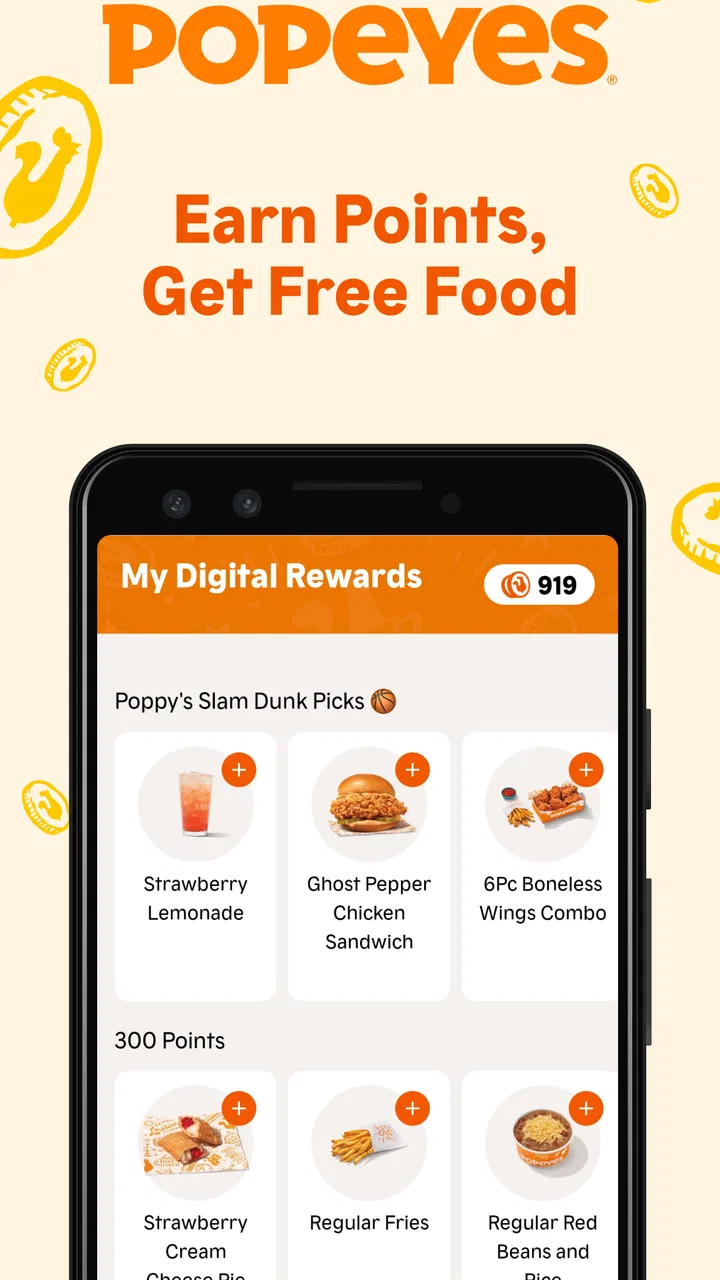
Yes, the app includes a rewards program where users can earn points for every purchase made through the app. These points can be redeemed for free food items or discounts on future purchases. The app frequently updates with new reward opportunities and exclusive member offers.
05Does the Popeyes® App notify users of special promotions?
Absolutely. The app sends notifications about the latest promotions, seasonal offers, and limited-time deals. Users can customize their notification preferences to ensure they receive updates that suit their interests. Opting in for notifications ensures you never miss out on exclusive app-only offers.
Pros
- User-friendly interface enhances navigation.
- Exclusive deals and offers available.
- Easy order customization options.
- Loyalty rewards for frequent users.
- Efficient order tracking feature.
Cons
- Menu updates can be delayed.
- Occasional app crashes reported.
- Limited payment options available.
- Location services can be inaccurate.
- User support response time varies.

Popeyes®
Gallery